Know about Historical Rock Fort Temple in Tiruchirapalli, Tamil Nadu - c1880's,
History:
Thiruchirappalli is a town of historical importance. It is famous for its
rock in the very heart of the town. The rock rises to a hight of 273 feet to be
climbed by a flight of 417 steps. There are Two Vinayaka Temples at the foot
and the top of the rock respectively and a Temple for Siva in between. Loard
Siva is known as THAYUMANAVAR. It means the God who turned Mother. There is a
legend about it. Ratnavadi a lady of the Marchant class and an ardent devotee of Siva was
eagerly waiting for the arrival of her mother to assist in her delivery. But
the mother was held up on the other side of the River Cauvery due to floods.
God himself came in the guise of the mother, acted as midwife and ministered to
her needs puzzled. At once the God disappeared and gave Dharshan to both from
the skies with his Divine Consort. From the day the God is called Thayum Anavar. The Goddess is called
Mattuvar Kuzhali Ammani which means the Long Haired Goddess wearing a garland
of flowers imbued with honey. This temple was built by King Mahendra Varman of the 7th Century.
Evidences of Jain occupation around the rock are still extant.
In detailed:
The oldest structure in the fort is a cave temple built by Pallavas in
580 AD. During the Cholas period, the nearby town of Woraiyur was their
capital, but the Pallavas did not keep control of this strategic city and lost
it to the Pandyas. The Cholas reasserted themselves in the 10th century. Trichy
continued to be in their possession until the decline of the empire, after
which it became a Vijayanagara stronghold. In mid 14th century, the region was
under the Delhi Sultanate, after Malik Kafur's raid on South India. They were
ousted and the region came under the control of Vijayanagara Empire. During the
early part of 16th century, the region came under the control of Madurai
Nayaks, who were the earlier governors of Vijayanagara Empire. However, it was
under the Nayaks of Madurai that Trichy prospered in its own right and grew to
be the city that it is today. The Nayaks of Madurai constructed the Rock Fort
Temple Lake along with major walls as foundations, establishing the town as a
trading city and later, their capital. The fort palace also witnessed the
transfer of power from Queen Meenakshi to Chanda Sahib, as he ruled in
conjunction with the French alliance. He lost this command when his uncle, the
Nawab of Arcot along with the British, seized the fort after the Carnatic wars.
This enabled the British to gain a foothold in Tamil Nadu and later South
India.
Major Battles
Nayak era
As the Fort was the capital of the Madurai Nayak Dynasty, the fort has
witnessed fierce battles. One of the largest was the Battle of Toppur for
supremacy between the Aravidu Dynasty of Vijayanagara Emperor and the Madurai
Nayaks. The former won, with support from the Mysore and Tanjore rulers in 16th
century. Later, the Nayaks faced fierce attacks from Bijapur, Mysore and
Marathas troops. The Fort complex formed the northwest territory to the Nayaks.
During their two-century rule, they had occasional skirmishes with their
neighbours, the Tanjore Nayaks, the Tanjore Marathas, and more often with the invading
Bijapur, Mysore and Maratha armies.
Carnatic Nawab Era
During the mid century, Chanda Sahib, aided by the French, made this fort
his home base. He battled with the combined forces of the Carnatic Nawab and
British. He was defeated in the Carnatic wars and was forced to cede his lands
to the British.
British Era
In the late 18th century, Hyder Ali was a major threat to the British, as
were the French who were still fighting for their colonial supremacy in this
region. By now, the town was firmly established as a Cantonment town and the
fort's gate was known as main guard gate.Robert Clive lived near the tank when
he was in Tiruchirappalli.
Structure
Origin of Rock
The Rock is said to be one of the oldest formations in the world. It is
3.8 billion years old, making it as old as the rocks in Greenland and older
than the Himalayas. Quartz, used in glass making, and feldspar, used in
ceramics, are found in this rock formation. It is also the highest and the
largest single rock on Earth that is a tourist attraction.
Constructions
As the name suggests, the Rock Fort Temple is situated on 83 metre-high
outcrops. The Pallavas initially built this temple, but the Nayaks made use of
its naturally fortified position and designed it again. It is a long climb up
the 344 steps cut into the stone to the top.
Temple Complex
- The temple complex in the fort complex is a collection of three temples:
- The Manikka Vinayakar temple at the foot of the hill, dedicated to Lord
Ganesha
- The Ucchi Pillayar Temple at the top of the hill, dedicated to Lord
Ganesha
- The Taayumaanavar Koyil Shivastalam, a rock cut temple dedicated to a
Nayaka era saint, Taayumaanavar
- Mathrubutheswarar, dedicated to Lord Shiva, has a lingam which is a
projection of the rock itself. It is reached by a flight of steps on the way to
Ucchi Pillayar Temple.
Rock-Cut Temple
The rock-cut temple in the hill temple complex was built during the
Pallava era and is named Lalitankura Pallaveswaram, with several inscriptions
attributed to Mahendravarman I. The Cholas, the Vijayanagar rulers and the
Nayaks of Madurai have made extensive contributions here. The two-storey-tall
Taayumaanava temples are considered to be a masterpiece of construction.
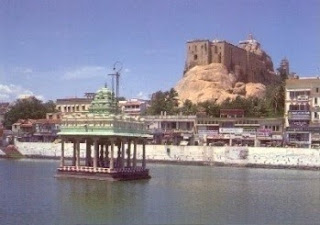
Tank
At the foot of the rock fort stand a tank and a pavilion which are used
during the float festival of the temples. These were by Viswanatha Nayaka of
Madurai to hold major religious festivals.
Near the tank is the house and 18th-century church built by Reverend
Schwartz of Denmark.
Palace
The mid-17th-century palace,now known as Rani Mangammal Mahal at the base
of the rock was built by Chokkanatha Nayak, now known as Rani Mangammal Mahal,
and features a Durbar hall. Historians assume that the palace was built by
Chokkanatha Nayak after he demolished three-fourths of the Tirumalai Nayak
palace. This palace was also the Durbar hall of Madurai Nayak when Tiruchapalli
was the capital during the years 1616 to 1634 and 1665 to 1736. Today, it
houses a museum and state government offices.
Main Guard Gate
The main guard gate was one of the main entrances for the fort complex.
It is located on the major fort wall enclosing the periphery of the rock fort
with its temples, lake, the palace and bazaars.The main entrance faces the
north.
Festivals and Events
Six worship services are offered each day here. This well-endowed temple
celebrates the annual Brahmotsavam in Chithirai. Aadi Pooram and the float
festival in Panguni are also of significance here. They were started by the
Nayaks of Madurai and are dedicated to both Shiva and Ganesha.
One favor? Would you
throw a link somewhere back to ttp://vedictemplesin.blogspot.com? Pretty
please? Thanks


